
The Anchor Slips
The Powell crisis and the GENIUS Act rulemaking gap are the same story — and the July 18 deadline doesn't move

Something is shifting at the core of the dollar system.
Not breaking. Not collapsing.
But moving — just enough to change what can be built on top of it.
That shift is not abstract; it is already showing up in the rules.
The Federal Reserve is under pressure.
Its stablecoin framework is still incomplete.
A criminal probe, a delayed rulemaking, and a $317bn market are now colliding.
These are not separate stories.
They are the same risk — expressed across two systems at once:
monetary policy and digital dollar infrastructure.
And the timing is not theoretical.
The regulatory clock is already running.
The administration that signed the GENIUS Act is now the primary risk to its own stablecoin agenda. The policy goal and the pressure campaign are pointing in opposite directions.
The Federal Reserve is not just at the center of a political confrontation.
It is also the institutional anchor of the system being built on top of it.
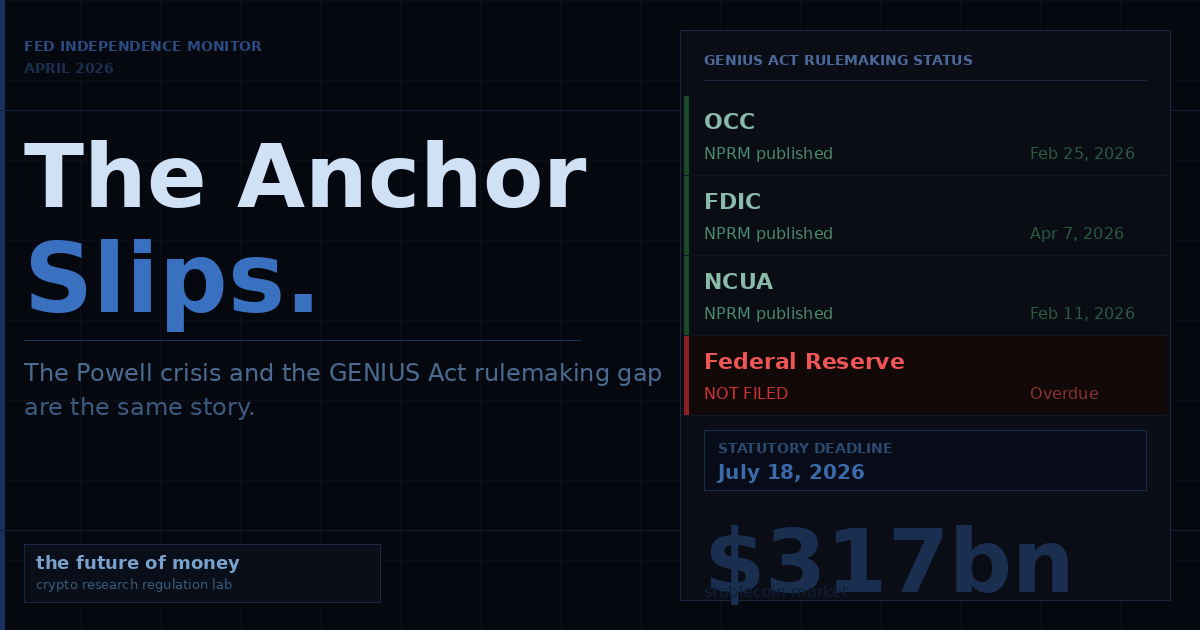
Three agencies have published their rules.
The Federal Reserve has not.
At the same time, its leadership is under direct political and legal pressure.
This is not parallel risk.
It is a single constraint, now binding across both systems.
In July 2025, the United States passed the GENIUS Act — the first comprehensive federal framework for dollar-backed stablecoins.
It gave regulators one year.
The deadline is July 18, 2026.
Nine months in:
rulemaking is underway
comment deadlines are approaching
firms are building against that framework
But one piece is missing.
The institution anchoring the system has not finished writing the rules.
Its chair is under investigation.
Courts have questioned the basis of that investigation.
The president has threatened removal if he does not step down by May 15.
Almost nobody covering the Fed crisis is tracking the regulatory consequences.
Almost nobody covering stablecoins is pricing the institutional risk.
This issue connects both.
Because the question is no longer whether digital dollars scale.
It is whether the anchor they depend on remains stable enough to support that scale.
This newsletter has tracked the progression:
January 2 — Silence as control
January 12 — Constraint under pressure
April 15 — Constraint openly contested
What was once a boundary is now the arena.
The short version: the political story and the regulatory story are the same story — and the clock is running.
I. The Provocation
Janet Yellen spoke at the HSBC Global Investment Summit in Hong Kong on Wednesday. The geography is doing some work. She chose an international conference in Asia — not Washington, not a domestic forum — to say what she said:
“How often does the president of a developed country express the view that the interest rate should be set to reduce the debt service cost? This is what you hear in a banana republic.”
And: “I have never seen a threat of this level to the Fed before.”
Former Federal Reserve chair. Former Treasury Secretary. The architect of much of the institutional framework now being contested. On the record. About the United States.
That is not a rhetorical point. It is a credibility event — the architects of the system publicly contesting the system’s integrity. That is a systemic variable changing state.
Banana republic, with footnotes.
II. The Mechanics of the Deadlock
Trump confirmed it Wednesday on Fox Business: “Then I’ll have to fire him. If he’s not leaving on time — I’ve held back firing him. I’ve wanted to fire him, but I hate to be controversial.”
The probe underpinning that threat has been twice challenged in court. US District Judge Boasberg found a “mountain of evidence” that subpoenas were issued to pressure Jerome Powell to cut rates or resign, while the government produced “essentially zero evidence” of wrongdoing. His conclusion was explicit: the investigation exists to make Powell “knuckle under.” On reconsideration, the court was direct: “The Government’s fundamental problem is that it has presented no evidence whatsoever of fraud. Even ignoring the audit entirely would not change that glaring fact.” The Justice Department is expected to appeal.
Enforcement has continued regardless. Prosecutors from Jeanine Pirro’s office made an unannounced visit to the Fed construction site and were turned away, referred instead to Fed counsel. The response was procedural: disputes belong in court.
Powell’s position has held. On March 18, he stated: “I have no intention of leaving the board until the investigation is well and truly over.” His term as governor runs to 2028. On the chair transition, he retains optionality: “I have not made that decision yet. I will make that decision based on what I think is best for the institution and for the people we serve.”
The confirmation path is blocked. Thom Tillis has conditioned support for Kevin Warsh on ending the probe. Without that vote, the nomination stalls in committee. A hearing is scheduled for April 21. John Thune has urged resolution. The investigation continues.
In a coordinated move today, all 11 Democrats on the Senate Banking Committee called to delay the hearing, linking the investigations into Powell and Cook to “a broader effort to exert control over the Fed”.
The system now binds into a single loop. The investigation constrains confirmation. Delayed confirmation extends Powell’s tenure. Extended tenure sustains the investigation.
The loop is self-reinforcing.
A DOJ appeal carries that loop across the GENIUS Act implementation window—past May 15 and into the July 18 deadline.
III. Follow the Money, Not the Subpoenas
The $2.5bn renovation probe is the mechanism. As a motive, it has been judicially questioned in court twice. As a pretext, it has served its purpose.
The real optimization function is simpler and larger.
The United States is carrying approximately $35 trillion in sovereign debt. Every 100 basis points of rate reduction saves meaningful money on new issuance and refinancing. Not marginal money — structural money that changes what fiscal paths are viable.
Trump’s pressure on Powell can be read as fiscal policy operating through institutional “intimidation”. The rate is the target. The Fed is the instrument. The renovation probe is the pretext.
The irony is structural. The administration that signed the GENIUS Act — the legislation designed to make dollar-pegged stablecoins the dominant global payment instrument — is now the primary source of institutional uncertainty undermining the dollar credibility those stablecoins depend on. The policy goal and the pressure campaign are pointing in opposite directions. One optimises for dollar dominance in digital finance. The other erodes the institutional anchor that makes dollar dominance possible.
This is not contradiction. It is what happens when short-term fiscal incentives override long-term institutional ones. The debt arithmetic wins in the room. The stablecoin market pays the price outside it.
Janet Yellen named the motive directly. Most coverage focuses on the mechanism rather than the objective.
The linkage is straightforward: debt → rates → pressure.
Which leads to the question that matters:
What happens to the $317bn stablecoin market when the institution writing its capital rules is itself under constraint—and already behind on rulemaking?
The answer sits in the regulatory calendar, the statutory design of the GENIUS Act, and a March 31 speech by a Fed governor that went largely unconnected to the crisis around it.
It sits below the line.
The political story ends here. The real story starts inside the rulebook.
The Fed’s piece of the framework is still missing. The committee that governs issuance can’t function without it. And the deadlines are already colliding.
This is where the GENIUS Act either holds — or starts to break.
If you’ve been reading The GENIUS Files since March, this is where both threads converge.
What breaks first isn’t the market. It’s coordination.
